After some years I will make this trip!! After the invitation from Ruth Dismuke-Blakely and Joann Benjamin I decided to accept it. It will be in May and it's time to prepare everything. From Europe there are four people going. It will be just amazing and I'm so excited.
The II Level will allow us to increase our knowledge and improve our practice.
For those who don't know, I suffer from Crohn's Disease and at this right moment I'm not working in HPOT. However I still have this dream and it doesn't matter if it needs to wait some years - I will do this!
Here I go New Mexico!
Monday, March 24, 2014
Tuesday, December 24, 2013
Merry Christmas!!!
Dear readers and followers,
I wish you all a merry christmas such as a great new year - full of news and motivation to work and progress!!
Thank you!
I wish you all a merry christmas such as a great new year - full of news and motivation to work and progress!!
Thank you!
Caesar learning with me how to lay portuguese guitar
Wednesday, November 20, 2013
Activity #4 - Collecting the objects
Hello from here! Sorry for not posting for so long.This activity aims to pretend a computer game about collecting objects around the arena walls.
The procedure is explained to the child, before its start.
One lap must be completed to show the objects arrangement. All the objects must be drawn on a paper and, right in the middle of the arena, the child must name all of them. Respecting the order of the drawings presented, the child must point and/or turn the head towards the object.
Depending on the equestrian skills the child presents, the horse must attain the object and stop near it. It can be done just in a oral-verbal form or the child can use the equestrian skills such as reins, etc.
You must attribute a number of points to each object, so this is the reinforcement to the child: collect objects and get more and more points!
Now, once more, everything depends on your goals and imagination!
Saturday, July 13, 2013
Finally in Europe!! - Level 1 Hippotherapy Treatment Principles Course
Finally, the Level 1 course of American Hippotherapy Association (Hippotherapy Treatment Principles Course) will be hosted in Europe - a great chance to get certified and having quality training.
Thanks to the initiative of Fundació Teràpia a Cavall, on behalf of Teresa Lloria, the course will take place in Barcelona (Spain), from 18 to 21 July 2013. It will be ministered by Ruth Dismuke-Blakely, MS/CCC-SLP, HPCS and Joann Benjamin, PT, HPCS - who are two trained professionals from the USA.

For us, SLP's who aim and work with horses, this will be very special due to the presence of Ruth Dismuke. She is the SLP I know who works with horses for more time - undoubtedly she has an invaluable contribution to the field.
I will be attending this course that, certainly, will expand my knowledge, volition and curiosity about this amazing treatment strategy.
Some pictures of this great experience will be posted in this blog.
See you soon!
Wednesday, April 3, 2013
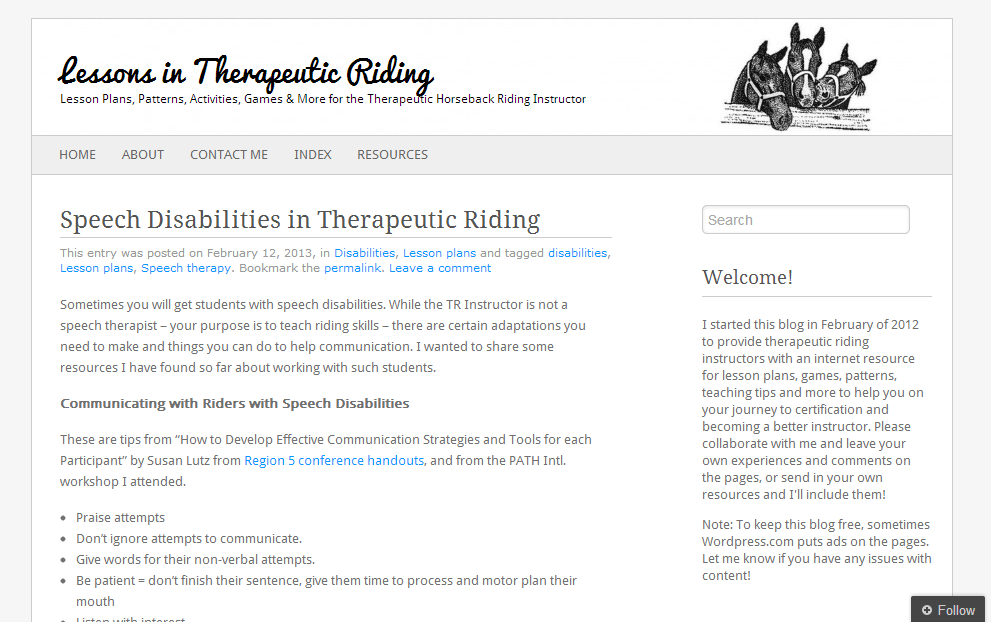
"Speech Disabilities in Therapeutic Riding" from Lessons in Therapeutic Riding Blog
During these days I was browsing and I found an interesting blog called Lessons in Therapeutic Riding.
The author wrote one post about communication impairments in individuals who receive therapeutic riding lessons. They have also a lot of resources and ideas that help professionals managing lessons/sessions with these individuals.
- Communicating with Riders with Speech Disabilities
- Learn about Speech Disabilities
- Addressing Speech
- Words of Caution
- Example Lesson Plan
For those who are interested on this post, please click here.
The author of the blog is a PATH Registered Level Therapeutic Horseback Riding Instructor - one of the aims of this blog is to fulfill and share the lack of resources and information in therapeutic riding. Please check out the blog clicking here.
Thanks to the blog author abou the permission to refer the post!
Tuesday, March 26, 2013
Activity #3 - Searching for that sound
Today's activity comprises some goals. It is not a very original one, but it aims to systematize my practice.
These are some goals which can be achieved with it:
-Identification of target sound positioned on word
-Decision about the sound that is included in that word (betwen two or more options)
-Production of target sound on word
-Identification of phonetic error made by therapist
All these goals must be selected depending on client level - they must not be random neither shuffled.
Procedure: the activity must be explained to the client. It can be performed inside or outside the arena and visual support must be chosen based on client skills. The funniest way is to do it outside trails, using natural elements as stimuli. While you are walking around, you can perform the tasks you previously decided, such as:
Oral production of words including target words:
-That bulb produces ... light;
-This signal is a ... circle/triangle;
-The flower is ... yellow;
Identification of words which include target sound:
-Present to the child two or more stimuli using real elements found on your trail. One of those objects must include the target sound when named. The child must identify that one.
Thursday, October 4, 2012
Activity #2 - Cause and Effect
As you could read some posts ago, each activity I plan have some major and many minor goals, addressing different areas at the same time.
The first activity I present here is called "Cause and Effect". The procedure is: the horse just will show the desired effect (start or stop moving) if the child shows the asked behavior.
Changing the gait of the horse will increase the joint attention of the child. The most used gait transitions are: walk-stop, stop-walk, walk-trot.
Depending on the field and pre-defined goals for each client we should ask the child to make one of the following behaviors:
-The child must say "go" to the horse start walking - this must increase the communicative intention, or address other goals. If the said expression is not good enough, the horse will not move - there will be no effect!!
-We can adapt it asking other forms: "start", "go <horse name>!".
-This is a good activity to promote oral motor skills - asking the child to make tongue snaps.
Every these examples must be applied after modeling it to the child.
This activity is particularly good to individuals with pervasive develop,entail disorders (eg autism). Some of these children doesn't tolerate a static horse. So it is a good motivation to teach other forms of start moving.
To non-verbal children they can do this activity striking their legs to promote the movement of the horse.
We can break the routine and doesn't move the horse, even though the child shows the desired behavior - it promotes joint attention and is funny to observe the effect!!
Subscribe to:
Posts (Atom)