Wednesday, April 3, 2013

"Speech Disabilities in Therapeutic Riding" from Lessons in Therapeutic Riding Blog

During these days I was browsing and I found an interesting blog called Lessons in Therapeutic Riding.
The author wrote one post about communication impairments in individuals who receive therapeutic riding lessons. They have also a lot of resources and ideas that help professionals managing lessons/sessions with these individuals.
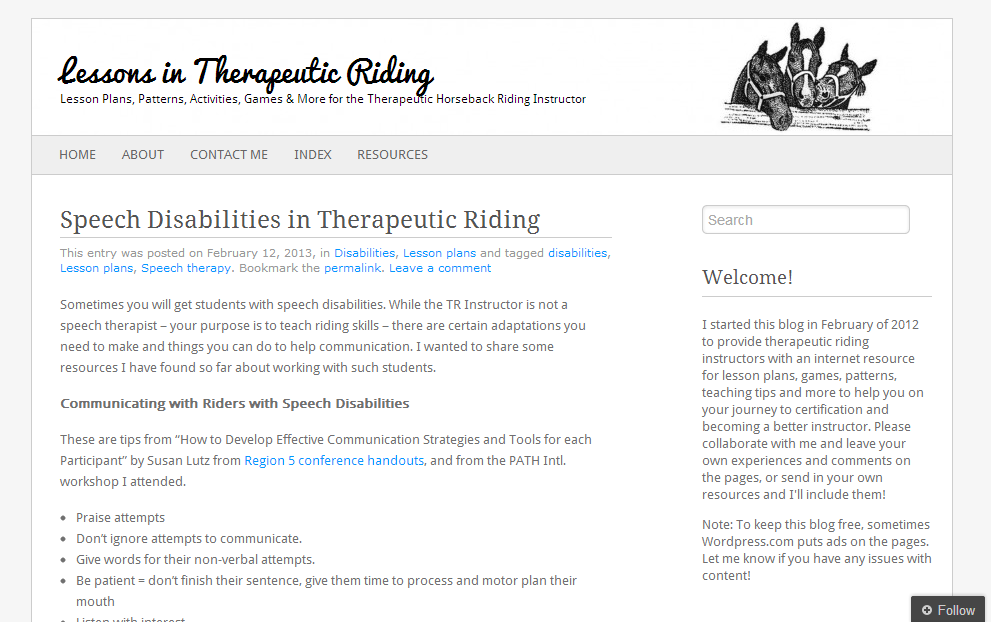
These are the main topics:
  • Communicating with Riders with Speech Disabilities
  • Learn about Speech Disabilities
  • Addressing Speech
  • Words of Caution
  • Example Lesson Plan


For those who are interested on this post, please click here.

The author of the blog is a PATH Registered Level Therapeutic Horseback Riding Instructor - one of the aims of this blog is to fulfill and share the lack of resources and information in therapeutic riding. Please check out the blog clicking here.

Thanks to the blog author abou the permission to refer the post!


Tuesday, March 26, 2013

Activity #3 - Searching for that sound

Today's activity comprises some goals. It is not a very original one, but it aims to systematize my practice.
These are some goals which can be achieved with it:
-Identification of target sound positioned on word
-Decision about the sound that is included in that word (betwen two or more options)
-Production of target sound on word
-Identification of phonetic error made by therapist
All these goals must be selected depending on client level - they must not be random neither shuffled.

Procedure: the activity must be explained to the client. It can be performed inside or outside the arena and visual support must be chosen based on client skills. The funniest  way is to do it outside trails, using natural elements as stimuli. While you are walking around, you can perform the tasks you previously decided, such as:
Oral production of words including target words:
-That bulb produces ... light;
-This signal is a ... circle/triangle;
-The flower is ... yellow;
Identification of words which include target sound:
-Present to the child two or more stimuli using real elements found on your trail. One of those objects must include the target sound when named. The child must identify that one.

Thursday, October 4, 2012

Activity #2 - Cause and Effect

As you could read some posts ago, each activity I plan have some major and many minor goals, addressing different areas at the same time.
The first activity I present here is called "Cause and Effect". The procedure is: the horse just will show the desired effect (start or stop moving) if the child shows the asked behavior.
Changing the gait of the horse will increase the joint attention of the child. The most used gait transitions are: walk-stop, stop-walk, walk-trot.
Depending on the field and pre-defined goals for each client we should ask the child to make one of the following behaviors:
-The child must say "go" to the horse start walking - this must increase the communicative intention, or address other goals. If the said expression is not good enough, the horse will not move - there will be no effect!!
-We can adapt it asking other forms: "start", "go <horse name>!".
-This is a good activity to promote oral motor skills - asking the child to make tongue snaps.

Every these examples must be applied after modeling it to the child.

This activity is particularly good to individuals with pervasive develop,entail disorders (eg autism). Some of these children doesn't tolerate a static horse. So it is a good motivation to teach other forms of start moving.
To non-verbal children they can do this activity striking their legs to promote the movement of the horse.

We can break the routine and doesn't move the horse, even though the child shows the desired behavior - it promotes joint attention and is funny to observe the effect!!

Friday, September 28, 2012

The whiteboard - all-in-arena solution!

Usually it is difficult to present the visual stimuli to my children inside the arena. Depending on the symbolic level of the child, we can do that task using a photo, PCS symbol, drawing, etc. It is not practical to have the different visual stimuli on our hands.
I have a small and rectangular whiteboard with a frame which allows me to pin anything there:
-Isolated images - naming task, describing pictures, object-image matching, etc
-Set of images - sentence building, sequencing task, etc
-Imans - movable letters, magnetic items, etc
 
I have always some whiteboard marker on my trunk - they must be thick and with different colors. To draw with them can be a fun and engaging task to both children and therapist -sometimes the results are very funny (especially when I draw horses jumping). Drawing is more flexible and perhaps faster than search pre prepared visual stimuli (such as plastified action images). It is also easy to erase, and children loves to do that with their hands! The activities can vary among object-drawing matching, image-drawing matching, sentence building, etc. We can write, and not just draw, as well. From the children viewpoint, it can be useful to attain some goals to ask the child to draw something - it can be challenging on horseback! The whiteboard can be supported by the horse's rump with the children turned back.
 
Tomorrow I will post some photos!

Friday, September 7, 2012

Saddlebag - a versatile material

Today I'm going to introduce you a material that I like a lot and is very useful. The saddlebag is composed by two bags - a bag on each side of the horse. It can be placed in front of the saddle or surcingle. Depending on the goal, it can be placed backward too. Mine has two hooks and two strips to attach it, as you can see in the picture below.


It is very versatile - we can use it in many activities. We can fill it with images or other visual stimuli so the child can name it and give to other person or do the image-object matching. We can ask to the child with autism to give us the object we ask (eg, mini brushes) wich he isn't actually seeing (a difficult task to some guys). The occupational therapist can adapt it with other locks (eg, button, velcro, shoelaces, etc) to achieve their goals. The child can transfer the asked object from one pocket to another. These are just some examples. The therapists can also save the material inside to next activity. You can associate the right bag to the tasks already done and left to the tasks which are not  done yet - for example, the child must pick up a picture from the left bag, name it (or something different)!  and put it in right bag. Beyond language/speech goals we are working sequential memory, improving attention and laterality.
I have been observing a funny thing: some children are afraid to put their hands in the pockets!

Tuesday, September 4, 2012

Activity #1 - Articulation placement on horseback

There is a fun game I use to implement in my EAT sessions, mainly with speech sound disorders. This activity is very flexible and is based on the positive and negative reinforcement - it is not just to articulatory therapy.
So, here it is:
After warming up (the child, the horse and us) we are able to start the activity. The arena just need to have the platform transition and the start point. The star point must be identified with something like a pole. All of us must be in the start point and this is the perfect time to explain to the child (and perhaps to the leader) how the game will run. The rules are simple: each time the child reaches a goal (like a well produced target sound, word, sentence, etc) the horse will move five steps forward counted aloud. If the child doesn't do it well (perhaps because is not paying attention) the horse will move two steps backward counted aloud. The game goal is to reach the end point (which can be the same as start) in shortest time.
As you can see it is very easy to perform and can be very exciting!

Thursday, August 23, 2012

Structuring the intervention environment

When we are working with people with attention deficit, we must have always a concern: the environment. Talking about our arena facility, I present you some concerns and strategies:
-Avoid times of day which have a lot of riders/people around (eg, new riders learning with their instructor makes a lot of noise and movement; school lessons; people working on the arena ground)
-Avoid meal times of horses - the horse is likely to be very reactive;
-When you ask the task to client, do it facing a wall or a place where there is nobody;
-Remove all visual distractors from arena such as: poles, wings, spires, buckets, balls
-Try not to present all material you are going to work with - I have a big plastic bag where I place all the material;
-Close the gate so the client and horse knows their boundaries and there is less temptations;
-If necessary, ask people around to make no noise.