Tuesday, April 4, 2017

Research from 2015 to 2016

Here is a list of references of scientific papers relating speech pathology and therapeutic use of horses from 2015 to 2016.

Used search strings:
-Google Scholar: (hippotherapy OR (therapeutic riding)) AND (speech OR (speech therapy) OR (speech pathology))
-Pubmed: (hippotherapy[Title/Abstract] OR therapeutic riding[Title/Abstract]) AND (speech[Title/Abstract] OR language[Title/Abstract] OR communication[Title/Abstract])


  • Gabriels, Robin L., et al. "Randomized controlled trial of therapeutic horseback riding in children and adolescents with autism spectrum disorder." Journal of the American Academy of Child & Adolescent Psychiatry 54.7 (2015): 541-549.
  • Thrall, Anna, and Matthew Moser. "Effects of hippotherapy on coordination of speech in a person with traumatic brain injury." (2015).
  • Mourey, Alyssa. The benefits of therapeutic horseback riding on the expressive language of toddlers who present with delays. Diss. 2015.
  • Mykhaylov, B. V., et al. "Application of animal-assisted therapy in children with autism spectrum disorders." Психіатрія, неврологія та медична психологія3.1 (5) (2016).
  • Maber-Aleksandrowicz, Sarah, Cerian Avent, and Angela Hassiotis. "A Systematic Review of Animal-Assisted Therapy on Psychosocial Outcomes in People with Intellectual Disability." Research in developmental disabilities 49 (2016): 322-338.
  • Anderson, Sophie, and Kerstin Meints. "Brief report: The effects of equine-assisted activities on the social functioning in children and adolescents with autism spectrum disorder." Journal of Autism and Developmental Disorders46.10 (2016): 3344-3352.
  • Hsieh, Yueh-Ling, et al. "Effects of hippotherapy on body functions, activities and participation in children with cerebral palsy based on ICF-CY assessments." Disability and Rehabilitation (2016): 1-11.


Tuesday, March 8, 2016

Equine Assisted Therapy as Strategy in Speech Language Pathology

Hello everyone!
As promised, here are the slides I presented at the 29th World Congress Of The IALP - Turin - Italy.
It was held in 2013 and was a great experience!
Please, if you want to cite, use this reference: Melo Pestana, P. & Vaz Freitas, S., 2013. Equine Assisted Therapy as Strategy in Speech Language Pathology. In Turin: 29th World Congress Of The IALP.


Friday, April 24, 2015

Interview with Ruth Dismuke-Blakely, MS/CCC-SLP, HPCS

A few days ago I challenged my dear Ruth Dismuke-Blakely to be interviewed. She answered to my questions and here they are!

Ruth Dismuke-Blakely, MS/CCC-SLP, HPCS is an internationally known Speech Language Pathologist and the first person formally known working with horses and SLP together. She is also the author of the very first researches that boosted these fields. Ruth owns Skyline Therapy since 1980 - a therapeutic business which runs Speech Therapy, Occupational Therapy and Physical Therapy with the help of the horse.
I was there and I tell you it is a very busy clinic - its major therapy room is nothing but a big arena where everything happens!


Pedro - You are Speech Language Pathologist (SLP) since 1980. Why did you choose this profession?
Ruth - I received my Masters of Science in Speech-Language Pathology in December, 1980.  At the age of 15 years, I volunteered at a state residential school for the developmentally disabled and had some very wonderful experiences there that made me know I wanted to become a speech-language pathologist.  I never wavered from that goal.

You were the first SLP using horses as a therapy strategy. How did it began?
I grew up in a professional horse family.  We bred, raised and trained American Quarter Horses.  In addition, I had given riding instruction to children and young adults beginning when I was 16 years old.  I really believed in what horses can do for people.  When I was in graduate school at the University of New Mexico I put together a treatment plan for a little boy with hearing impairment that centered on using equine movement and the naturalistic context of the riding setting to address his speech and language deficits.  My clinical supervisor from the university would meet me with the family and the little boy at our local fairgrounds.  I would bring two of our lesson horses and my mother to help me as horse support.  I knew nothing of therapeutic riding or hippotherapy but we fashioned a very productive treatment plan for this little boy.  Based on that work, I was awarded two research grants – one for $8000 US for a pilot study and one for $80,000 US for a more comprehensive follow up study.  The results of both significantly supported the use of the horse as a treatment tool in speech and language therapy.
Following that research our local school district approached me to “contract” my services using the horse in treatment.  We incorporated what is now Skyline Therapy Services on September 21, 1982 and immediately had 52 clients to see with a range of diagnoses from the Albuquerque Public Schools Special Education program.  Soon after, our local rehabilitation hospital began referring adults with traumatic brain injuries.  Very quickly we were offering speech-language therapy, occupational therapy and physical therapy to children and adults with a range of special needs.

What kind of patients are most referred to Skyline Therapy?
Over the past 33 years we have treated children and adults with all manner of diagnosis including traumatic brain injury, stroke, neuromuscular deficits like cerebral palsy, apraxia, autism spectrum disorders, sensory processing deficits, a broad range of genetic disorders like Down syndrome and Rhett syndrome, specific language impairment, phonological processing deficits, attention deficit disorder, auditory processing disorder, and some spinal cord injury.  We have also seen individuals with hearing impairment and visual impairment.

Regarding Speech Therapy goals, what are the main benefits the horse brings?
First and foremost, equine movement can facilitate all of the neurophysiology that support speech production and language use.  In order for an individual to “talk” efficiently, they must have good core postural control, good sensory processing/modulation, good respiratory support for speech sound production, motor control and coordination/timing.  The multi-dimensional dynamic movement provided by a well-trained well managed therapy horse can be used to positively impact all of these systems.  The speech-language pathologist is then able to incorporate very standard speech/language therapy techniques with the movement of the horse to promote very strong gains in communication for the client.  The setting itself is rich in pragmatic loading so there are always ample opportunities for “talking” in naturalistic and meaningful environment.   We see excellent carryover into the client’s daily living as well.

After some years you still need to have an educative role about this field in the society and even with other health professionals. How do you do it?
I love to share my knowledge and experiences in using hippotherapy as a treatment strategy within my speech and language therapy services.  I have an outstanding team of therapists and horse professionals that work for me here at Skyline Therapy.  This makes it possible for me to travel and teach other health professionals about the value of equine movement as a treatment strategy in not only speech-language therapy but in occupational therapy and physical therapy as well.

During our career some patients are unforgettable. Can you highlight one special moment or patient from Skyline Therapy?
In 33 years of practicing, there have been so many wonderful “moments’.  So many patients have said their first words or taken their first steps here at Skyline.  One of my favorite stories involves a little boy who had very severe motor speech apraxia and was only able to produce a mid-vowel sound /uh/.  We began using the horse’s movement to impact his neurological system and within a five sessions he was able to produce more speech sounds.  At roughly the 7th session, we increased the amount of movement he was receiving dramatically.  It was a Thursday afternoon.  I was worried that we had possibly overwhelmed his system as he was pretty tired and grumpy afterwards.  On Saturday, his mother called me and was overcome with emotion.  This little boy had independently produced 10 intelligible words that day – literally began talking after that.  I have always believed that the horse’s movement “jump started” his neuromotor system and allowed him to overcome his motor speech apraxia to a large degree.

Hippotherapy is not a “miracle cure” but for many individuals with special needs, it has shown itself to be a powerful addition to their therapy plans – generating some very profound improvements to speech and language use.

Friday, February 13, 2015

Research from 2014

The last post was most successful of this blog. Therefore, I'll try to do it continuously. I also provide, whenever possible, the link to download the article.
Taking into account the criteria listed in last post, I will update my database until the end of 2014.

Disclaimer:  the links I provide are not mine, the articles are hosted and free available on other websites/servers. As the author of this blog, I am not responsible for the content of the articles neither the way they are shared.

Cohort based studies:


Jordhøy, Maia Camilla. "Horse Assisted Therapy and Self-esteem-The impact of Horse Assisted Therapy on self-esteem: A study involving youth in treatment for substance use disorder." (2014). Download

Lanning, Beth A., et al. "Effects of Equine Assisted Activities on Autism Spectrum Disorder." Journal of autism and developmental disorders 44.8 (2014): 1897-1907. Download

Dabelko-Schoeny, Holly, et al. "Equine-assisted intervention for people with dementia." Anthrozoos: A Multidisciplinary Journal of The Interactions of People & Animals 27.1 (2014): 141-155.


Literature review:

Dawson, Bradford Tyler. "An Exploratory Mixed Methodology Study Into the Theoretical Foundation of Equine-Assisted Psychotherapy." (2014). Download - the author also collects data from some professionals.


Case studies:
Valle, Lila Maria Ornelas, Aparecida Yumi Nishimori, and Kátia Nemr. "Speech therapy in hippotherapy." Revista CEFAC 16.2 (2014): 511-523. Download

Tuesday, June 24, 2014

Research from 2013

This is something I usually do - I do a search in my usual databases and I collect all the scientific articles that addresses the bond between speech therapy and hippotherapy. While doing this, I really don't care what words the authors use or if they use the word hippotherapy the way I do - what is important is how they do it and how they achieve the outcomes with the people. The articles don't need to address specifically or directly the speech therapy, rather they need to address the way they join both fields and whether they report outcomes in communication related areas. The studies, which address just the balance or physical improvements, were rejected.

Disclaimer: the links I provide are not mine, the articles are hosted and free available on other websites/servers. As the author of this blog, I am not responsible for the content of the articles neither the way they are shared.

Here is a list that is supposed to be up to date.


Cohort based studies:

Lanning, Beth A., et al. "Effects of Equine Assisted Activities on Autism Spectrum Disorder." Journal of autism and developmental disorders (2014): 1-11. Download

Valle, Lila Maria Ornelas, Aparecida Yumi Nishimori, and Kátia Nemr. "Speech therapy in hippotherapy." Revista CEFAC 16.2 (2014): 511-523. - Download

Ajzenman, Heather F., John W. Standeven, and Tim L. Shurtleff. "Effect of Hippotherapy on Motor Control, Adaptive Behaviors, and Participation in Children With Autism Spectrum Disorder: A Pilot Study." American Journal of Occupational Therapy 67.6 (2013): 653-663. - Donwload - Supported by Human & Horses Research Foundation

Boyer, Valerie E. "Using Animal-Assisted Therapy to Facilitate Social Communication: A Pilot Study." Revue canadienne d’orthophonie et d’audiologie| Vol 38.1 (2014). - Download

Literature review:

Long, Sarah. "Hippotherapy as a Tool for Improving Motor Skills, Postural Stability, and Self Confidence in Cerebral Palsy and Multiple Sclerosis." Sound Neuroscience: An Undergraduate Neuroscience Journal 1.2 (2013): 3. - Download

Jacobs, Connie I. "Animal-Assisted Therapy and the Child-Animal Bond: Children's Well-being and Behavior." (2013). - Donwload

Carriker, Morgan N. "Perceived Satisfaction of Equine-Assisted Therapy: A Qualitative Study of Family Narratives." (2013). - Donwload

Case studies:

Maestas sDPT, Rachel Y. "Does Hippotherapy Improve Gross Motor Function in Children with Cerebral Palsy?." Orthopaedics Research Journal (2013): 41. - Download (YES, it was done based on an Skyline Therapy kid!!!)

Tenorio, Reena. "Does equine movement positively impact functionalabilities in children with Autism Disorder?!." (2014). - Download (Once more, Skyline Therapy as stage of good research!)

General reports:

Lepore, Natasha, and Lawrence Yau. "Hippotherapy: A holistic approach to rehabilitation." WURJ: Health and Natural Sciences 4.1 (2013): 2. - Download

Sunday, June 22, 2014

Boogie Board - material review

My last buy was the Boogie Board in Dallas Airport. I found that the toys are very different from Europe - the shop was Geppeto's. The staff is just wonderful and very nice. Although it is a small airport shop (in terminal A), I lost myself inside. I bought a Folkmanis' frog puppet and a Boogie Board.
The last one is specially useful when working with horses and dirt. I think it is just amazing - here is a picture of it! All kids want one! It is really a success and it really substitutes my whiteboard.


There is plenty of them but I own the classical one. It is an electronic board and that allows us to write on its surface using a pen with a plastic hard tip. With just one click, the image just disappears.
It has a lot of advantages:
-With the arena dirt it doesn't stop its work, against the normal pens - with sand they get stuck or get bad anyway;
-We don't need to recharge the battery, because it has a watch battery that allows a lot of usage!
-It is not that expensive such as a normal tablet - so, if the horse or the child breaks you just loose $34;
-You don't waste that amount of paper.

However, with the dirty it can get scratched.

Tuesday, June 10, 2014

Lecture - IALP 2013, Turin, Italy

Dear readers,

Finnaly online, so I can provide you the handouts of the lecture entitled "The Equine Assisted Therapy as Strategy in SLP Intervention". This was a free paper presented at World Congress of IALP 2013. Please, feel free to download it at: http://goo.gl/4KNBDA.

You can cite it as follows: Pestana, P. and Freitas, S. (2013). The Equine Assisted Therapy as Strategy in SLP Intervention. 29th World IALP Congress 2013, Turin, Italy.

Monday, March 24, 2014

Level II - Hippotherapy - AHA - New Mexico

After some years I will make this trip!! After the invitation from Ruth Dismuke-Blakely and Joann Benjamin I decided to accept it. It will be in May and it's time to prepare everything. From Europe there are four people going. It will be just amazing and I'm so excited.
The II Level will allow us to increase our knowledge and improve our practice.

For those who don't know, I suffer from Crohn's Disease and at this right moment I'm not working in HPOT. However I still have this dream and it doesn't matter if it needs to wait some years - I will do this!

Here I go New Mexico!


Tuesday, December 24, 2013

Merry Christmas!!!

Dear readers and followers,

I wish you all a merry christmas such as a great new year - full of news and motivation to work and progress!!


Thank you!

Caesar learning with me how to lay portuguese guitar

Wednesday, November 20, 2013

Activity #4 - Collecting the objects

Hello from here! Sorry for not posting for so long.
This activity aims to pretend a computer game about collecting objects around the arena walls.
The procedure is explained to the child, before its start.
One lap must be completed to show the objects arrangement. All the objects must be drawn on a paper and, right in the middle of the arena, the child must name all of them. Respecting the order of the drawings presented, the child must point and/or turn the head towards the object.
Depending on the equestrian skills the child presents, the horse must attain the object and stop near it. It can be done just in a oral-verbal form or the child can use the equestrian skills such as reins, etc.
You must attribute a number of points to each object, so this is the reinforcement to the child: collect objects and get more and more points!

Now, once more, everything depends on your goals and imagination!

Saturday, July 13, 2013

Finally in Europe!! - Level 1 Hippotherapy Treatment Principles Course

Finally, the Level 1 course of American Hippotherapy Association (Hippotherapy Treatment Principles Course) will be hosted in Europe - a great chance to get certified and  having quality training.

Thanks to the initiative of Fundació Teràpia a Cavall, on behalf of Teresa Lloria, the course will take place in Barcelona (Spain), from 18 to 21 July 2013. It will be ministered by Ruth Dismuke-Blakely, MS/CCC-SLP, HPCS and Joann Benjamin, PT, HPCS - who are two trained professionals from the USA.

For us, SLP's who aim and work with horses, this will be very special due to the presence of Ruth Dismuke. She is the SLP I know who works with horses for more time - undoubtedly she has an invaluable contribution to the field.
I will be attending this course that, certainly, will expand my knowledge, volition and curiosity about this amazing treatment strategy.

Some pictures of this great experience will be posted in this blog.

See you soon!

Wednesday, April 3, 2013

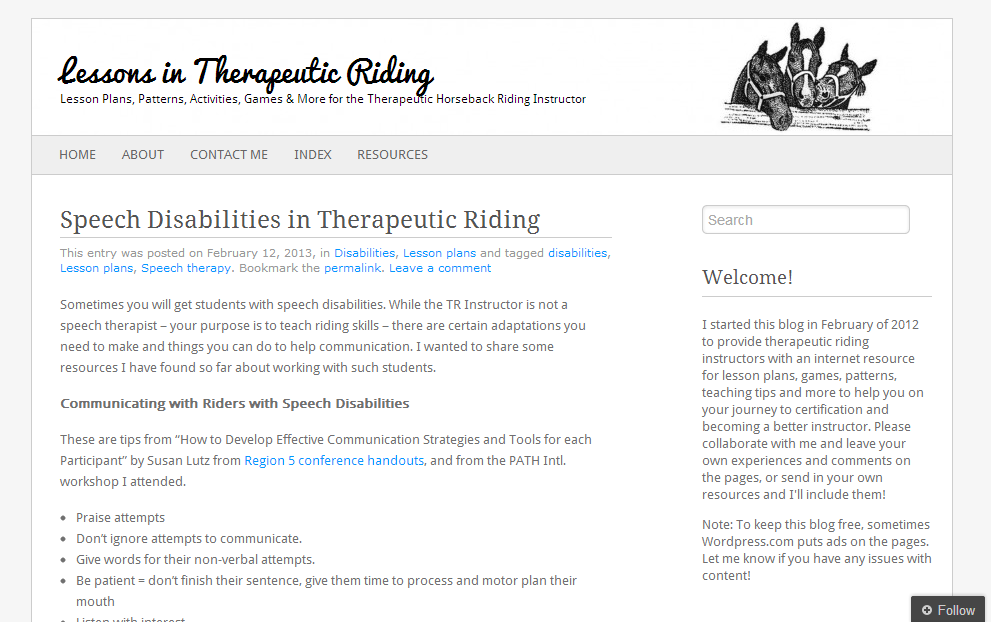
"Speech Disabilities in Therapeutic Riding" from Lessons in Therapeutic Riding Blog

During these days I was browsing and I found an interesting blog called Lessons in Therapeutic Riding.
The author wrote one post about communication impairments in individuals who receive therapeutic riding lessons. They have also a lot of resources and ideas that help professionals managing lessons/sessions with these individuals.
These are the main topics:
  • Communicating with Riders with Speech Disabilities
  • Learn about Speech Disabilities
  • Addressing Speech
  • Words of Caution
  • Example Lesson Plan


For those who are interested on this post, please click here.

The author of the blog is a PATH Registered Level Therapeutic Horseback Riding Instructor - one of the aims of this blog is to fulfill and share the lack of resources and information in therapeutic riding. Please check out the blog clicking here.

Thanks to the blog author abou the permission to refer the post!


Tuesday, March 26, 2013

Activity #3 - Searching for that sound

Today's activity comprises some goals. It is not a very original one, but it aims to systematize my practice.
These are some goals which can be achieved with it:
-Identification of target sound positioned on word
-Decision about the sound that is included in that word (betwen two or more options)
-Production of target sound on word
-Identification of phonetic error made by therapist
All these goals must be selected depending on client level - they must not be random neither shuffled.

Procedure: the activity must be explained to the client. It can be performed inside or outside the arena and visual support must be chosen based on client skills. The funniest  way is to do it outside trails, using natural elements as stimuli. While you are walking around, you can perform the tasks you previously decided, such as:
Oral production of words including target words:
-That bulb produces ... light;
-This signal is a ... circle/triangle;
-The flower is ... yellow;
Identification of words which include target sound:
-Present to the child two or more stimuli using real elements found on your trail. One of those objects must include the target sound when named. The child must identify that one.

Thursday, October 4, 2012

Activity #2 - Cause and Effect

As you could read some posts ago, each activity I plan have some major and many minor goals, addressing different areas at the same time.
The first activity I present here is called "Cause and Effect". The procedure is: the horse just will show the desired effect (start or stop moving) if the child shows the asked behavior.
Changing the gait of the horse will increase the joint attention of the child. The most used gait transitions are: walk-stop, stop-walk, walk-trot.
Depending on the field and pre-defined goals for each client we should ask the child to make one of the following behaviors:
-The child must say "go" to the horse start walking - this must increase the communicative intention, or address other goals. If the said expression is not good enough, the horse will not move - there will be no effect!!
-We can adapt it asking other forms: "start", "go <horse name>!".
-This is a good activity to promote oral motor skills - asking the child to make tongue snaps.

Every these examples must be applied after modeling it to the child.

This activity is particularly good to individuals with pervasive develop,entail disorders (eg autism). Some of these children doesn't tolerate a static horse. So it is a good motivation to teach other forms of start moving.
To non-verbal children they can do this activity striking their legs to promote the movement of the horse.

We can break the routine and doesn't move the horse, even though the child shows the desired behavior - it promotes joint attention and is funny to observe the effect!!

Friday, September 28, 2012

The whiteboard - all-in-arena solution!

Usually it is difficult to present the visual stimuli to my children inside the arena. Depending on the symbolic level of the child, we can do that task using a photo, PCS symbol, drawing, etc. It is not practical to have the different visual stimuli on our hands.
I have a small and rectangular whiteboard with a frame which allows me to pin anything there:
-Isolated images - naming task, describing pictures, object-image matching, etc
-Set of images - sentence building, sequencing task, etc
-Imans - movable letters, magnetic items, etc
 
I have always some whiteboard marker on my trunk - they must be thick and with different colors. To draw with them can be a fun and engaging task to both children and therapist -sometimes the results are very funny (especially when I draw horses jumping). Drawing is more flexible and perhaps faster than search pre prepared visual stimuli (such as plastified action images). It is also easy to erase, and children loves to do that with their hands! The activities can vary among object-drawing matching, image-drawing matching, sentence building, etc. We can write, and not just draw, as well. From the children viewpoint, it can be useful to attain some goals to ask the child to draw something - it can be challenging on horseback! The whiteboard can be supported by the horse's rump with the children turned back.
 
Tomorrow I will post some photos!

Friday, September 7, 2012

Saddlebag - a versatile material

Today I'm going to introduce you a material that I like a lot and is very useful. The saddlebag is composed by two bags - a bag on each side of the horse. It can be placed in front of the saddle or surcingle. Depending on the goal, it can be placed backward too. Mine has two hooks and two strips to attach it, as you can see in the picture below.


It is very versatile - we can use it in many activities. We can fill it with images or other visual stimuli so the child can name it and give to other person or do the image-object matching. We can ask to the child with autism to give us the object we ask (eg, mini brushes) wich he isn't actually seeing (a difficult task to some guys). The occupational therapist can adapt it with other locks (eg, button, velcro, shoelaces, etc) to achieve their goals. The child can transfer the asked object from one pocket to another. These are just some examples. The therapists can also save the material inside to next activity. You can associate the right bag to the tasks already done and left to the tasks which are not  done yet - for example, the child must pick up a picture from the left bag, name it (or something different)!  and put it in right bag. Beyond language/speech goals we are working sequential memory, improving attention and laterality.
I have been observing a funny thing: some children are afraid to put their hands in the pockets!

Tuesday, September 4, 2012

Activity #1 - Articulation placement on horseback

There is a fun game I use to implement in my EAT sessions, mainly with speech sound disorders. This activity is very flexible and is based on the positive and negative reinforcement - it is not just to articulatory therapy.
So, here it is:
After warming up (the child, the horse and us) we are able to start the activity. The arena just need to have the platform transition and the start point. The star point must be identified with something like a pole. All of us must be in the start point and this is the perfect time to explain to the child (and perhaps to the leader) how the game will run. The rules are simple: each time the child reaches a goal (like a well produced target sound, word, sentence, etc) the horse will move five steps forward counted aloud. If the child doesn't do it well (perhaps because is not paying attention) the horse will move two steps backward counted aloud. The game goal is to reach the end point (which can be the same as start) in shortest time.
As you can see it is very easy to perform and can be very exciting!

Thursday, August 23, 2012

Structuring the intervention environment

When we are working with people with attention deficit, we must have always a concern: the environment. Talking about our arena facility, I present you some concerns and strategies:
-Avoid times of day which have a lot of riders/people around (eg, new riders learning with their instructor makes a lot of noise and movement; school lessons; people working on the arena ground)
-Avoid meal times of horses - the horse is likely to be very reactive;
-When you ask the task to client, do it facing a wall or a place where there is nobody;
-Remove all visual distractors from arena such as: poles, wings, spires, buckets, balls
-Try not to present all material you are going to work with - I have a big plastic bag where I place all the material;
-Close the gate so the client and horse knows their boundaries and there is less temptations;
-If necessary, ask people around to make no noise.

Wednesday, August 22, 2012

Emotional and behavioral challenges


The disordered development probably means a rowdy childhood. Its impact in social interaction usually vary betwen excessive shyness and hiperactivity. From all of the most common carachteristics, the worst are the oppositive behaviors.

Monday, August 20, 2012

"With Autism on Horseback"

This presentation was done by me during November 2011 at University Fernando Pessoa - Oporto, Portugal. The event was a workshop called "Autism Voices" wich included some oral presentations on non traditional therapies with autism. I decided to call "With Autism on Horseback" to mine. I hope you like!